
battery
solar
dry battery
wet battery
tubular
AGM
Gel
Dry vs. Wet Batteries for Solar: Comparing Sealed Lead Acid and Tubular
2025-10-24T00:00:00.000Z
💧 Sealed vs. Vented: Understanding Solar Lead-Acid Batteries
This comparison focuses on the traditional lead-acid category—the most common budget option globally.
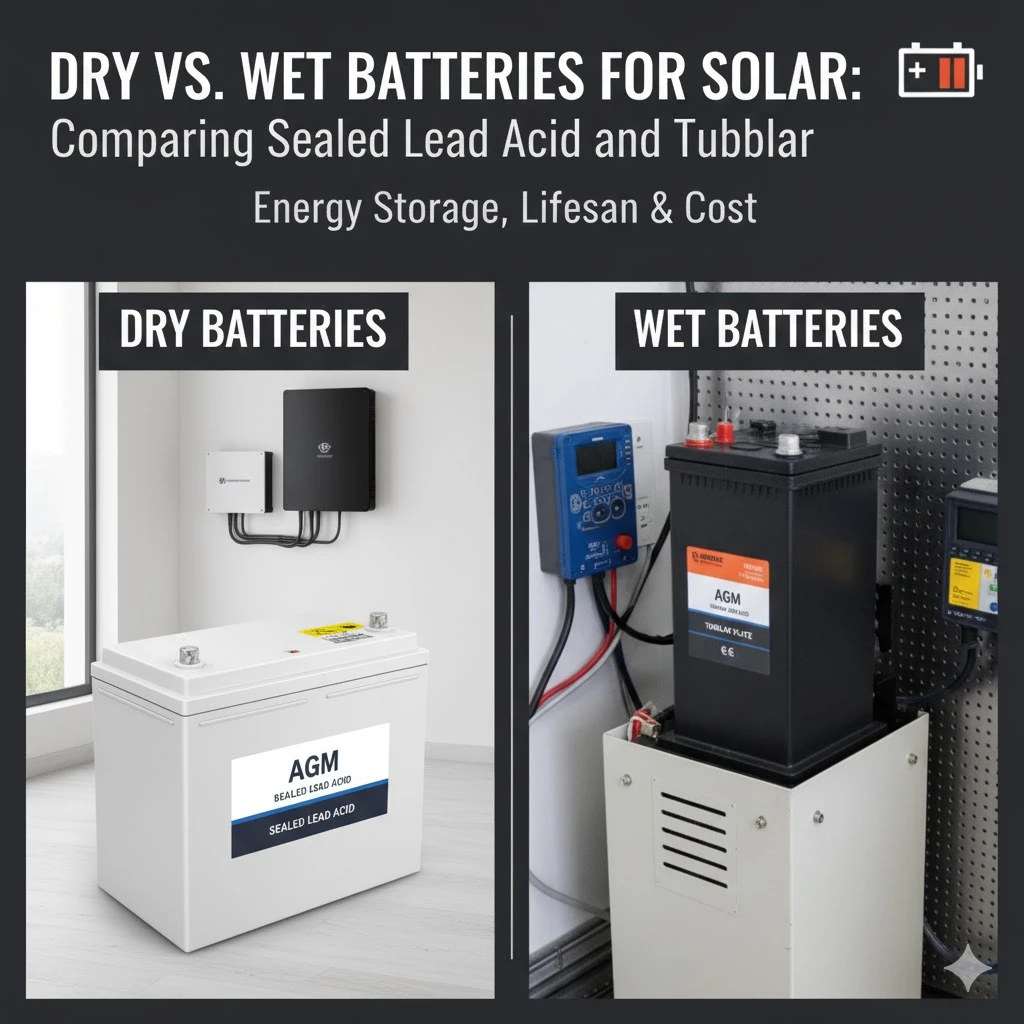
1. Wet Batteries (Flooded/Tubular)
Known as 'Wet Cell' or 'Flooded Lead-Acid' batteries (specifically deep-cycle Tubular batteries are best for solar).
- ✅ **Pros:** Excellent deep-cycle life within the lead-acid range, lowest cost, and robust for high-temperature environments.
- ❌ **Cons:** Requires regular maintenance (water top-up), emits hydrogen gas (needs ventilation), and can leak.
- **Category Match:** Tubular Battery
2. Dry Batteries (Sealed Lead Acid - AGM/Gel)
These are 'Dry Cell' or 'Sealed Maintenance Free' (SMF) batteries, which include AGM (Absorbent Glass Mat) and Gel technologies.
- ✅ **Pros:** Maintenance-free, sealed construction (non-spillable), safer for indoor use.
- ❌ **Cons:** Shorter deep-cycle life than Tubular, sensitive to overcharging, and generally higher cost than flooded.
- **Category Match:** Although Lithium is best, the 'Dry Battery' term often refers to sealed lead acid (AGM/Gel).
Recommendation
For the best long-term cost-effectiveness and performance in the traditional lead-acid segment, the **Tubular Battery** (Wet) is generally superior for solar systems that undergo deep, daily cycling. However, if zero maintenance and safety/indoor installation are critical, opt for a sealed **Gel/AGM (Dry) Battery** or, ideally, a Lithium-ion solution. 🔋