
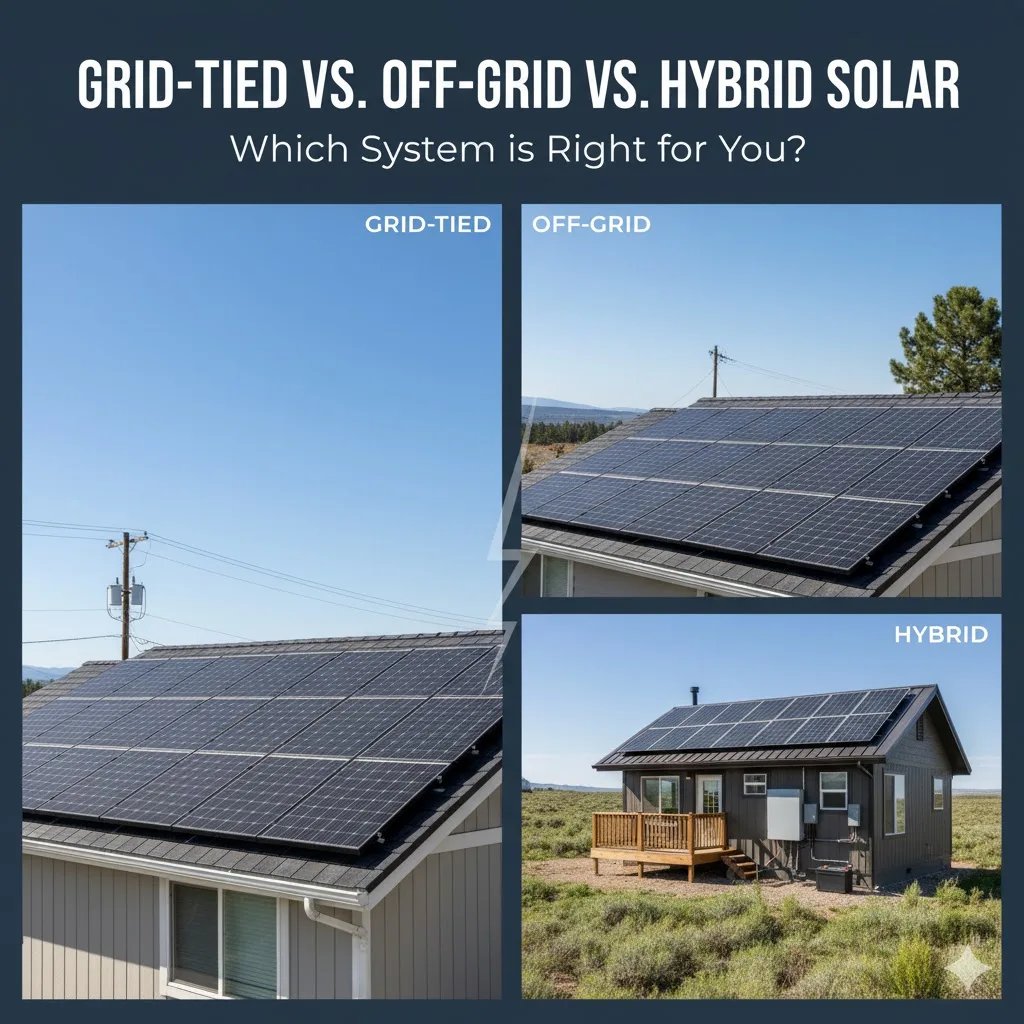
grid tied
off grid
hybrid solar
solar battery
net metering
Grid-Tied vs. Off-Grid vs. Hybrid Solar: Which System is Right for You?
2025-10-24T00:00:00.000Z
🔗 The Connection Decision: Your Solar System Configuration
Choosing between grid connection, total independence, or a mix of both affects cost, reliability, and functionality.
1. Grid-Tied System (Most Common Residential)
Connected to the utility power grid, allowing you to sell excess power back (Net Metering).
- ✅ **Pros:** Lowest cost, highest efficiency, no batteries needed, net metering savings.
- ❌ **Cons:** Goes down during grid power outages (for safety reasons).
- **Ideal For:** Homeowners focused purely on cost savings who do not require backup power.
2. Off-Grid System (Total Independence)
Completely disconnected from the utility company, requiring battery storage for all power needs.
- ✅ **Pros:** Complete energy independence, no electric bills ever.
- ❌ **Cons:** Highest cost, requires careful load management, high maintenance for battery bank.
- **Ideal For:** Remote cabins, tiny homes, or areas where grid connection is unavailable or too expensive.
3. Hybrid System (The Best of Both Worlds)
Connected to the grid but includes a battery backup. Excess power goes to the battery first, then to the grid. It's the most reliable option, providing power during an outage while still allowing for net metering. 💡