Reduce disruption
Keep selected control, communication and security circuits operating during an outage instead of waiting for the grid to recover.

LITHIUM ENERGY STORAGE / INDUSTRIAL & COMMERCIAL
Industrial lithium battery backup, designed around your critical operations.
CM Solar provides industrial Battery Bank Systems (BBS), also known as Battery Energy Storage Systems (BESS). A lithium battery stack, compatible inverter or power conversion system, controls and protection work together to keep selected business loads powered when grid supply fails.
Bharuch · Ankleshwar · Dahej · Gujarat
An outage can stop controls, interrupt billing and communications, or leave essential equipment without power. Start with the loads that matter most, then design the backup around them.
Keep selected control, communication and security circuits operating during an outage instead of waiting for the grid to recover.
Match the stored energy to your critical kW load and required hours. Include reserve and ageing margins in the design.
Assess your UPS and generator together with lithium storage. Sensitive equipment may still need an online UPS.
A BBS stores electrical energy for use during an outage. It can charge from the grid, from a compatible solar system, or both. It serves a similar backup purpose to a UPS, but the complete system design determines transfer time, power quality and suitability for each critical load.
Grid power or available solar supplies the site and charges the battery. The control strategy maintains the backup reserve agreed for your operations.
A compatible inverter or PCS supplies the dedicated critical-load board. The switching arrangement, discharge power and stored energy determine what stays on and for how long.
The system returns to the configured operating mode and recharges. Generator integration and solar charging can be assessed where supported by the chosen equipment.
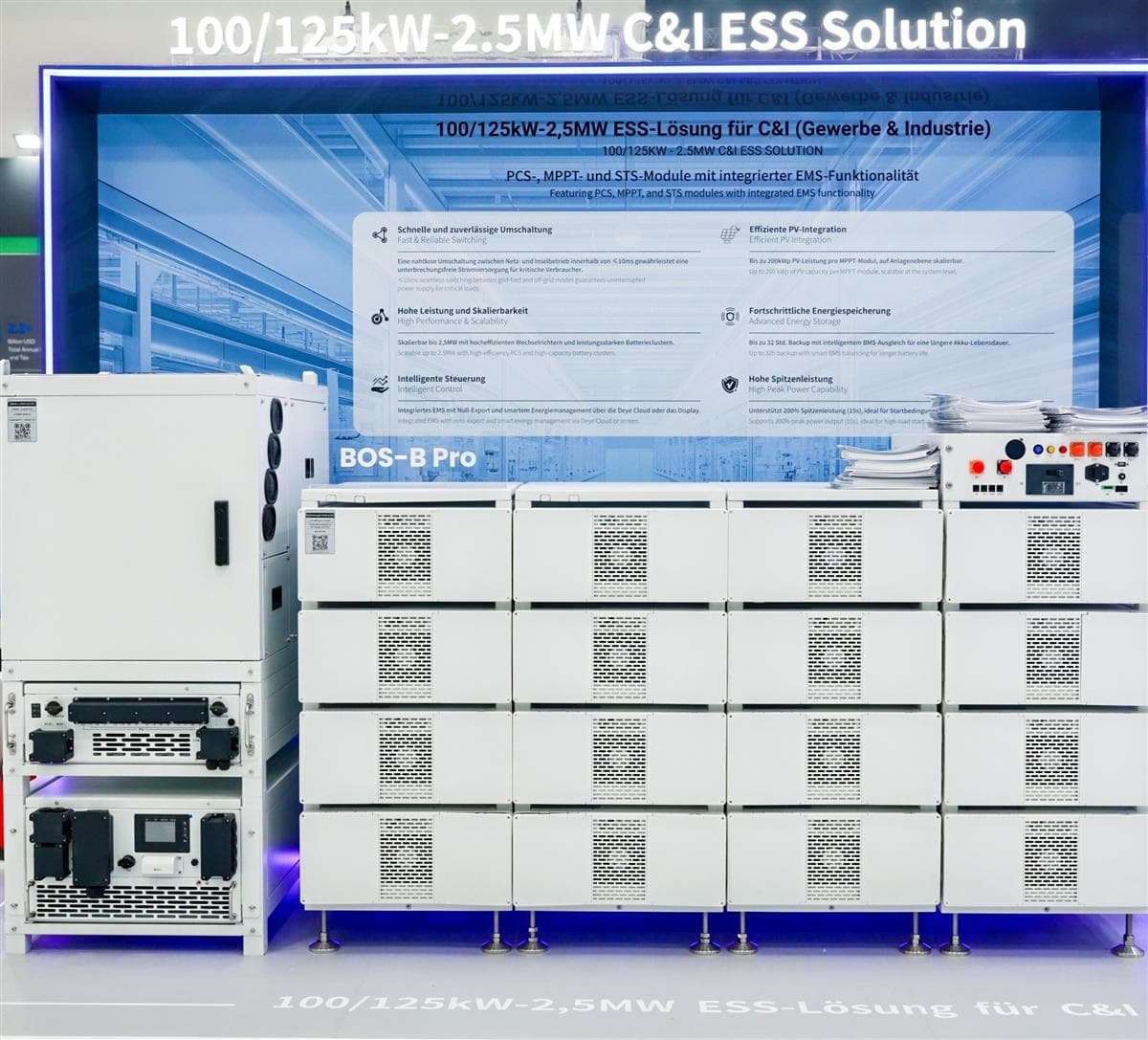
CM Solar works with Deye, V-TAC and PVblink options. We choose the equipment around compatibility, application requirements, technical documentation and local support—not the brand name alone.
Hybrid inverter families include the three-phase SUN-5/6/8/10/12K-SG04LP3-EU low-voltage range. Separately, BOS-G offers high-voltage LiFePO4 rack storage using 5.12 kWh modules. These are different voltage architectures, not a recommended inverter-battery pair. We select a compatible regional configuration.
Manufacturer informationA storage portfolio covering low- and high-voltage batteries and integrated energy-storage formats. The appropriate rack or cabinet depends on project scale and site conditions.
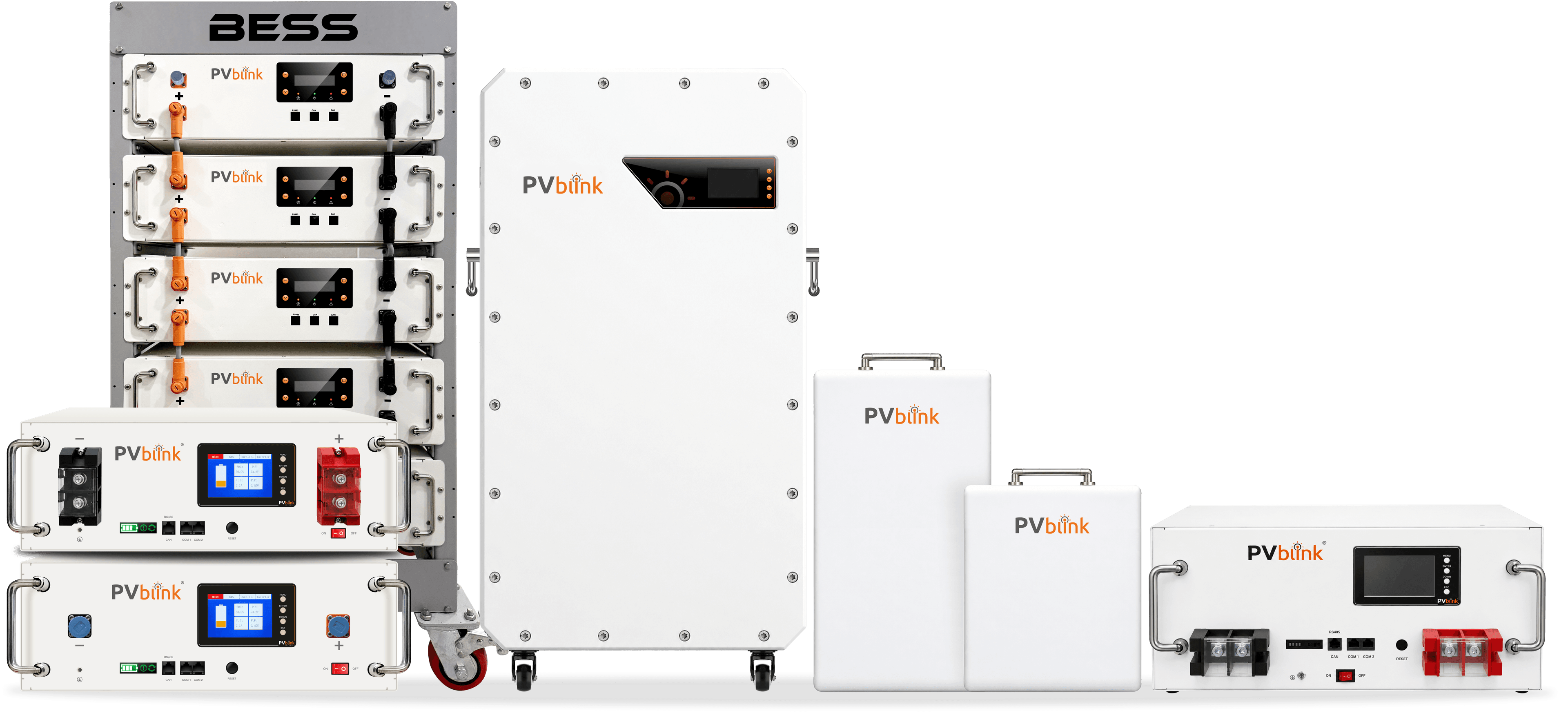
Manufacturer informationPVblink publishes BESS information, inverter connection diagrams and product documentation for selecting and understanding a system.
Manufacturer informationExplore manufacturer product families without pricing. These are assessment options, not a claim of current stock or a pre-approved inverter–battery combination. Exact models, certificates, local warranty and compatibility are confirmed in your proposal.
Deye
Modular lithium battery storage and compatible power-conversion equipment for commercial and industrial energy storage. Select the exact PCS, battery rack and switching arrangement after a load study.
C&I storage architecture | Modular battery racks | Matched PCS and controls
V-TAC
Cabinet and larger ESS formats for business energy storage. Backup, solar integration and generator coordination depend on the configured system and controls.
Commercial ESS portfolio | Cabinet and container formats | Project-specific design
PVblink
Battery storage with monitoring and a compatible hybrid system for selected business loads. Industrial suitability, transfer behaviour and the required output must be confirmed for your critical-load schedule.
Battery management | Storage and backup | Model-dependent scalability
Compare the power-conversion equipment separately from the energy stored in its battery bank. Solar panels are optional for these backup designs. The listed manufacturer storage systems still need a confirmed inverter/PCS, protection and transfer arrangement for critical-load backup.
Swipe horizontally to compare all columns
| System / battery family | Inverter / PCS output | Battery modules per bank | Nominal bank voltage | Nominal stored units | Usable DC energy | Matching / backup conditions |
|---|---|---|---|---|---|---|
| Deye BOS-B Pro-A3 + PCSView datasheet | 100 kW PCS option | 15–16 × BOS-B-Pack16-A3 modules (PCS-only off-grid arrangement) | 768–819.2 V | Approx. 241.15–257.23 kWh / units | Approx. 217.04–231.51 kWh at 90% depth of discharge | PCS-only off-grid matching requires 15–16 modules. Adding MPPT changes the matching rules; see brochure. |
| Deye BOS-B Pro-A3 + PCSView datasheet | 125 kW PCS option | 15–16 × BOS-B-Pack16-A3 modules (PCS-only off-grid arrangement) | 768–819.2 V | Approx. 241.15–257.23 kWh / units | Approx. 217.04–231.51 kWh at 90% depth of discharge | The same battery-bank energy can be paired with a different rated PCS. Discharge current, voltage and load conditions must be checked. |
| V-TAC / Deye BOS-A set, SKU 11994View datasheet | Compatible high-voltage inverter / PCS selected separately | 21 × 7.68 kWh BOS-A-PACK modules + control box | 806.4 V | 161.28 kWh / units | 145.15 kWh (catalogue) | Catalogue describes on-grid commercial storage. Island-mode backup must be verified for the complete selected system. |
| V-TAC / Deye BOS-G Pro set, SKU 12355View datasheet | Compatible high-voltage inverter / PCS selected separately | 16 × 5.12 kWh BOS-G-Pack 5.1 modules + control box | 819.2 V | 81.92 kWh / units | 73.73 kWh (catalogue) | Standard EU cluster in the referenced catalogue; regional availability and backup compatibility require confirmation. |
Sources: Deye BOS-B Pro-A3 brochure, pages 1 and 7; V-TAC solar catalogue, pages 72–75. Deye nominal totals use 51.2 V × 314 Ah per module (16.0768 kWh); the brochure rounds module energy to 16.08 kWh. Deye usable values apply 90% depth of discharge and are rounded. These are DC battery figures before AC conversion losses. No battery rack alone provides uninterrupted AC power: a validated complete system is required.
1 kWh = 1 electricity unit. The examples below multiply the rated energy of identical battery packs; they do not approve a particular bank size for an inverter. More battery storage increases potential backup duration, not inverter output power.
Swipe horizontally to compare all columns
| Battery model | Nominal voltage | 1 battery: nominal energy | 2 batteries: nominal energy | 4 batteries: nominal energy | 8 batteries: nominal energy | Manufacturer expansion limit / matching |
|---|---|---|---|---|---|---|
| Deye SE-G5.1 Pro-BView datasheet | 51.2 V | 5.12 kWh | 10.24 units | 20.48 units | 40.96 units | Battery-family limit: up to 64 parallel packs; up to 32 without additional external setup. Inverter approval still required. |
| V-TAC VT48100E-P2View datasheet | 51.2 V | 5.12 kWh | 10.24 units | 20.48 units | 40.96 units | Maximum pack count is not stated on catalogue page 62. Confirm the approved inverter/BMS and battery manual. |
| PVblink PVBBS5.12K-LV-M1View datasheet | 51.2 V | 5.12 kWh | 10.24 units | 20.48 units | 40.96 units | The battery PDF does not specify a model-specific maximum pack count. Confirm approved parallel configuration. |
| PVblink PVBBS16.07K-LV-M1 / LV-W-M1View datasheet | 51.2 V | 16.0768 kWh | 32.15 units | 64.31 units | 128.61 units | The battery PDF does not specify a model-specific maximum pack count. Confirm approved parallel configuration. |
Nominal energy is not the electricity guaranteed at your AC loads. Usable energy is lower after SOC reserve, discharge settings and inverter losses. Do not mix battery models or connect low-voltage packs in series without manufacturer approval. The 2-, 4- and 8-battery columns are energy calculations only; exact supported counts require model-specific approval. PVblink 16.07 models are rated 51.2 V × 314 Ah = 16.0768 kWh per pack; totals are rounded.
The grid supplies the facility and charges the battery through a compatible inverter or PCS. During an outage, an engineered switching arrangement isolates and supports the critical-load board.
Conceptual flow only. The site-specific single-line diagram defines protection, switching, bypass and UPS integration.
A battery bank is not automatically a zero-break online UPS. We assess acceptable interruption time, voltage quality, harmonics, starting surge, phase imbalance and required autonomy. Where necessary, a dedicated online UPS supports sensitive loads while the lithium storage system provides longer-duration upstream backup.
Modular storage selected for usable energy, discharge power, installation environment and future expansion requirements.
A compatible hybrid inverter or bidirectional PCS converts stored DC energy into AC power for the assessed loads.
BMS communication, state-of-charge monitoring, alarms and supported energy-management controls coordinate system operation.
Dedicated distribution, protection, isolation, bypass and transfer arrangements designed for the selected backup architecture.
Space, access, ventilation or cooling, earthing, cable routes and applicable electrical and fire-safety requirements assessed for the site.
Commissioning, outage and recovery checks, monitoring setup, operating guidance and a service plan as agreed in the project scope.
We assess the actual equipment and its power requirements before selecting a system.
PLC panels, control systems, instrumentation and selected production support loads. Large motors and process machinery require detailed load studies.
Networking, servers, access control, billing and business communications. Zero-break equipment needs an appropriate UPS architecture.
Security, emergency communications and selected instruments or refrigeration controls, subject to application-specific requirements.
Illustration: 20 kW of steady critical load for 2 hours needs 40 kWh delivered to the loads. At 90% usable battery energy and 90% conversion efficiency, the starting nominal battery estimate is about 49.4 kWh, before ageing, reserve and design margins. Inverter or PCS power, surge capacity and redundancy must be assessed separately.
A clear scope, compatible equipment and practical support at every stage.
Review loads, grid outages, backup hours, installation space and existing electrical equipment.
Define inverter power, battery energy, compatible components, protection and installation scope.
Install the agreed system, set operating priorities and verify battery communication.
Demonstrate outage and recovery operation, explain monitoring and agree the service plan.
It is a battery-based energy storage installation using lithium battery modules, a BMS, a compatible inverter or PCS, switching equipment and protection. It stores energy and supplies selected loads during outages or other configured operating periods.
No. A BESS may have a transfer interval and different power-conditioning characteristics. For loads requiring zero-break supply, an online UPS or an appropriately validated architecture is required. We review the equipment tolerance before choosing the design.
No. A suitable system can charge from the grid and provide battery backup. Solar can be included to support daytime loads and recharge storage when the selected equipment and site design support it.
It can reduce generator use for suitable loads and outage durations, but it is not a universal replacement. Long outages may need a generator, sufficient solar or another charging source. We can assess a coordinated battery-and-generator design.
No. Battery voltage, power limits, approved BMS protocol, firmware, protection and manufacturer compatibility must match. Low-voltage and high-voltage batteries cannot be interchanged without a compatible system design.
Share the site location, critical-load list with kW or kVA, phase details, motor starts, required backup time, acceptable transfer interval, existing UPS or generator details, solar details and available installation space.
Share your critical-load schedule, required backup duration and existing UPS, generator or solar details. CM Solar serves Bharuch, Ankleshwar, Dahej and nearby industrial areas in Gujarat.
Looking for solar with day-and-night battery backup? Explore hybrid solar