HANSOT / SOLAR + STORAGE

Check how the battery will recharge.
Hybrid solar & BESS in Hansot

Shade and seasonal recharge

Shade and seasonal recharge / Site assessment brief

For a Hansot solar-and-storage enquiry, backup duration is only half the discussion. Explain how the system is expected to recharge after supporting the agreed loads, including days when solar production or available charging time differs from the initial assumption.

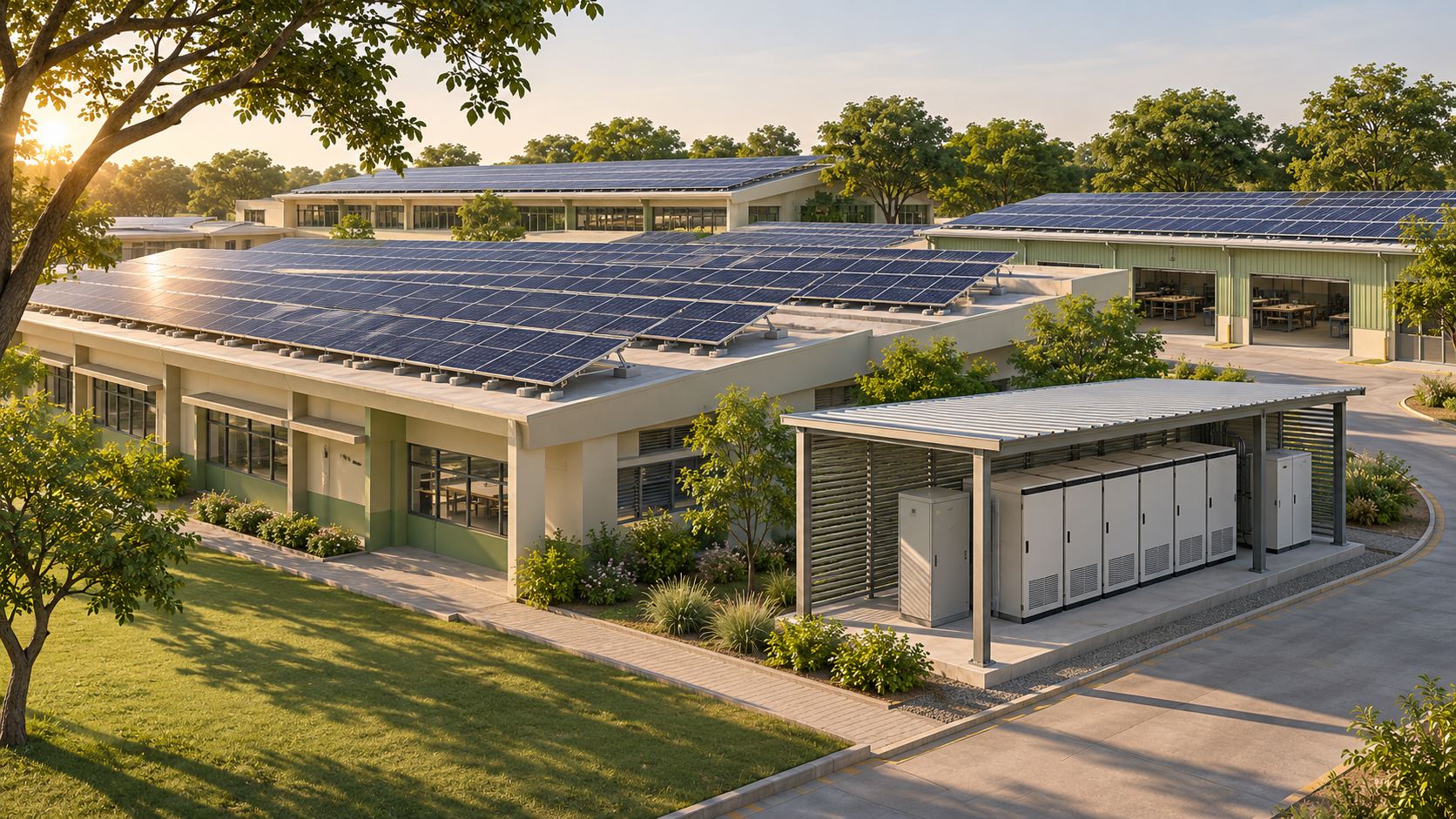
Concept illustration for shade and seasonal recharge: Large low-rise institutional and workshop campus with extensive rooftop solar, trees set back from array and a clean battery cabinet shelter, low sunny angle showing shadows clearly, soft green and sand palette
Shade and seasonal recharge. AI-generated installation concept, not a photograph of an actual Hansot site or a completed CM Solar project.

01 / THE LOCAL BRIEF

Connect backup duty to a realistic recharge plan

This guide treats recharge planning as a site-level design question. It makes no claim about local outage frequency or a guaranteed solar yield for Hansot; roof conditions and the intended duty must be assessed individually.

Record the hours available for charging and the essential demand that continues during that period. Discuss what should happen if the battery has not recovered its intended reserve before the next support window. A quoted autonomy figure should not conceal an untested recharge assumption.

Test a lower-generation day on paper

Use a conservative scenario to discuss the next day's reserve after a planned backup duty. Identify which loads or schedules may change if recharge is incomplete. The exercise is a planning check, not a forecast of a particular day's generation or a promise of indefinite autonomy.

Technical reference: EIA: electricity storage and capacity ↗

02 / CHOOSE THE RIGHT STARTING POINT

Shade and seasonal recharge: solar and storage roles.

BESS means battery energy storage system; BSS is also used for battery storage system. Neither term alone specifies backup power, duration or transfer performance.

SOLAR + BATTERY

Solar planning: shade and seasonal recharge

Assess roof shading and the usable generation period rather than assuming every hour of daylight delivers the same output. Compare solar energy available for charging with the business loads that use generation at the same time.

How hybrid solar works →
STORED ENERGY + CONTROL

Battery brief: shade and seasonal recharge

If grid charging is included, confirm the intended schedule, available connection capacity and applicable operating constraints. State the reserve policy and the priority between routine energy use and readiness for an interruption.

Explore industrial BESS →

03 / AN ILLUSTRATIVE STARTING POINT

Selected daytime and evening essentials

Power in kW and stored energy in kWh are different specifications. Both need to be checked.

3 kWSelected running load
3 hIllustrative duration
~11.1 kWhNominal energy before margins

3 kW × 3 h ÷ (0.90 × 0.90)

An illustrative 3 kW running load over three hours.

Recharge time and generation yield are not determined by this energy calculation.

Assumes 90% usable battery energy and 90% conversion efficiency for explanation only. Actual output, usable capacity, ageing, temperature, reserve and surge requirements change the design. This is not a quoted package or a backup guarantee.

Reference: EIA explanation of power and energy capacity ↗

04 / MAKE THE SITE DISCUSSION USEFUL

Describe the recharge window and reserve.

Proposed charging window and operating hours

Roof shading and generation assumptions

Demand that continues while charging

Minimum reserve and incomplete-recharge response

Ask for the complete daily energy balance

Request charging-power assumptions, reserve settings and an explanation of the energy balance. Ask which conditions reduce the available backup duration and how the operator will recognise them.

QUESTIONS FOR HANSOT

Questions about shade and seasonal recharge

Does a battery always refill in one sunny day?

No. PV output, concurrent loads, charging limits and the energy used during backup all affect recharge. The complete daily energy balance must be checked.

Can the grid recharge the battery too?

That depends on the selected system, settings and connection requirements. Include grid charging explicitly in the operating scope if it is intended.

YOUR SITE, YOUR OPERATING REQUIREMENTS

Discuss shade and seasonal recharge in Hansot.

Start with the exact site address and your shade and seasonal recharge questions. Request charging-power assumptions, reserve settings and an explanation of the energy balance. Ask which conditions reduce the available backup duration and how the operator will recognise them. Confirm survey availability and service arrangements for the premises directly with CM Solar.

CM Solar & Electrical Solution · Bholav, Bharuch, Gujarat. These are service-area guides, not separate branch-office listings.

Contact details and Bharuch address →