PANOLI GIDC / SOLAR + STORAGE

Give the battery a suitable operating environment.
Hybrid solar & BESS in Panoli GIDC

Battery thermal management

Battery thermal management / Site assessment brief

For a Panoli GIDC project, battery placement should be assessed before the layout is fixed. Enclosure rating, cooling duty, air paths and maintenance access need to match the actual equipment location rather than the appearance of a cabinet in a catalogue.

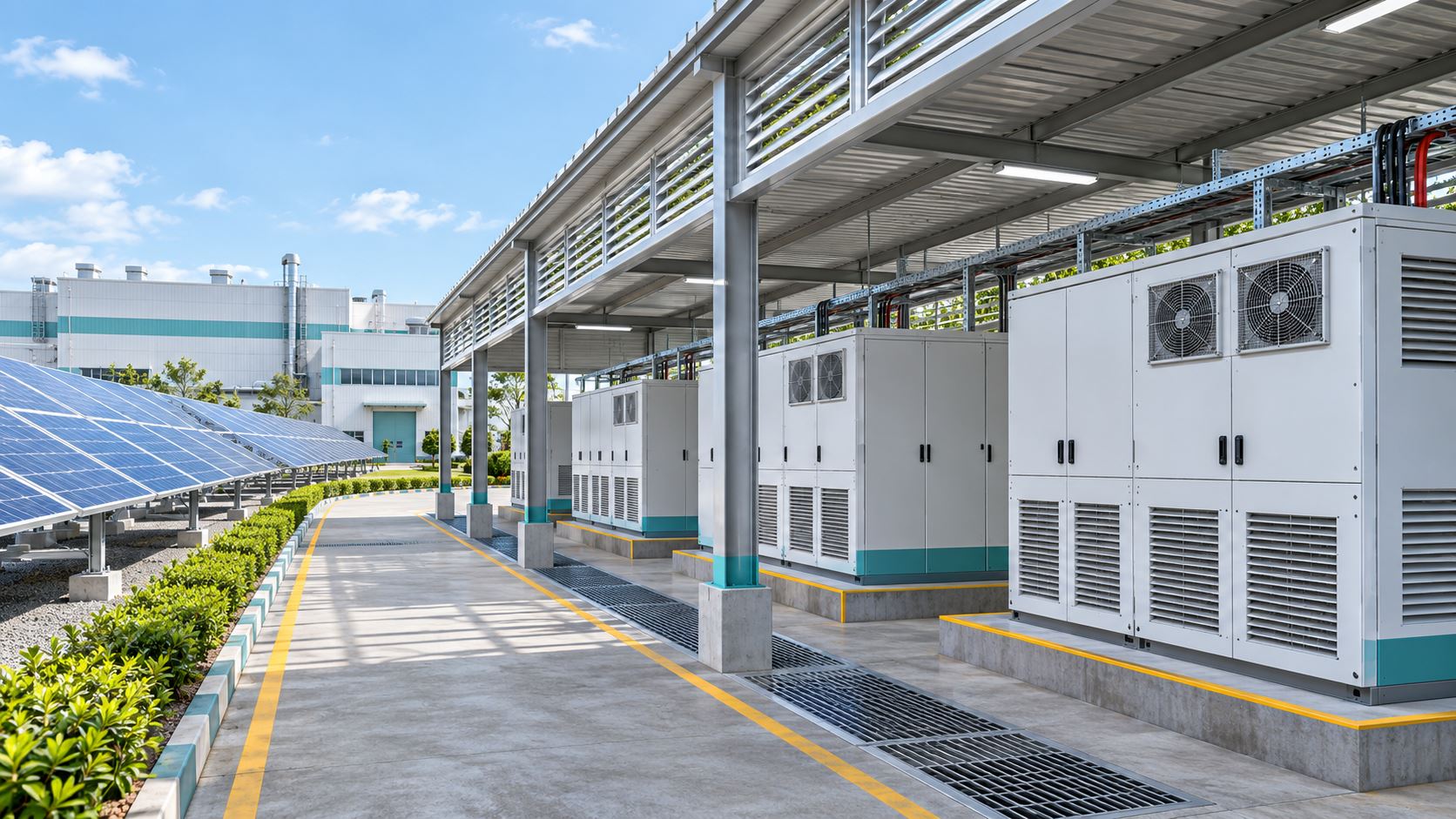
Concept illustration for battery thermal management: Expansive factory solar installation with large battery cabinets under ventilated open-sided canopy in dedicated service yard, foreground cooling grilles visible, human-eye-height wide view, white and muted turquoise midday
Battery thermal management. AI-generated installation concept, not a photograph of an actual Panoli GIDC site or a completed CM Solar project.

01 / THE LOCAL BRIEF

Assess the equipment location through the year

GIDC identifies Panoli as a notified industrial area. That establishes the estate context, not the temperature, contamination level or environmental suitability of a particular installation position inside an individual unit.

Record likely heat sources, direct solar exposure, nearby exhaust and conditions that may obstruct cooling or service. Ask the site team which operating conditions are known and which require measurement. Avoid placing equipment first and leaving the environmental review until commissioning.

Create a location suitability checklist

Photograph each candidate area from several directions and note exposure, obstructions, access and nearby activities. Compare those observations against the selected equipment requirements. Record unresolved questions for the design review instead of treating an enclosure protection rating as a complete statement of environmental suitability.

Location reference: GIDC estate directory ↗

02 / CHOOSE THE RIGHT STARTING POINT

Battery thermal management: solar and storage roles.

BESS means battery energy storage system; BSS is also used for battery storage system. Neither term alone specifies backup power, duration or transfer performance.

SOLAR + BATTERY

Solar planning: battery thermal management

Include the PV inverter location and cable paths in the same assessment. Roof generation and battery operation can have different environmental constraints; one sheltered area should not be assumed suitable for every component.

How hybrid solar works →
STORED ENERGY + CONTROL

Battery brief: battery thermal management

Ask for the specified operating envelope, cooling requirements, auxiliary consumption and any derating conditions. Confirm access to filters and serviceable parts. Installation suitability must be established against manufacturer requirements and the site assessment.

Explore industrial BESS →

03 / AN ILLUSTRATIVE STARTING POINT

Selected estate service loads

Power in kW and stored energy in kWh are different specifications. Both need to be checked.

28 kWSelected running load
0.75 hIllustrative duration
~25.9 kWhNominal energy before margins

28 kW × 0.75 h ÷ (0.90 × 0.90)

A hypothetical 28 kW service-load group for 45 minutes.

Cooling auxiliaries, environmental margins and derating need site-specific allowances.

Assumes 90% usable battery energy and 90% conversion efficiency for explanation only. Actual output, usable capacity, ageing, temperature, reserve and surge requirements change the design. This is not a quoted package or a backup guarantee.

Reference: EIA explanation of power and energy capacity ↗

04 / MAKE THE SITE DISCUSSION USEFUL

Assess the proposed battery environment.

Candidate-area photos and heat sources

Known ambient and exposure conditions

Cooling and service-clearance requirements

Site review of equipment environmental suitability

Include cooling and maintenance assumptions

Request a layout with service clearances, manufacturer environmental requirements and responsibility for cooling maintenance. Clarify how auxiliary consumption and any output derating enter the performance assumptions.

QUESTIONS FOR PANOLI GIDC

Questions about battery thermal management

Does an outdoor enclosure rating cover every industrial environment?

No. Temperature, contaminants, corrosion exposure and installation details need their own review against the selected equipment's stated requirements.

Does cooling use some of the stored energy?

Battery-system auxiliaries may consume energy. Ask how cooling and control consumption are included in the backup-duration estimate for the intended operating conditions.

YOUR SITE, YOUR OPERATING REQUIREMENTS

Discuss battery thermal management in Panoli GIDC.

Start with the exact site address and your battery thermal management questions. Request a layout with service clearances, manufacturer environmental requirements and responsibility for cooling maintenance. Clarify how auxiliary consumption and any output derating enter the performance assumptions. Confirm survey availability and service arrangements for the premises directly with CM Solar.

CM Solar & Electrical Solution · Bholav, Bharuch, Gujarat. These are service-area guides, not separate branch-office listings.

Contact details and Bharuch address →